For centuries a tourbillon watch has been considered one of the most complicated and hence exclusive timepieces. Only the world’s best watch makers are able to make their own tourbillon movements and as requirements of both the master watchmakers and the components used are very high the annual output of tourbillon watches remain very limited. A watch with tourbillon remains a manifestation of superior watch making craftsmanship and is a luxury available only to a selected audience.
SEA-GULL has developed its own tourbillion in-house in the tradition started by the French watchmaker Abraham-Louis Breguet, who invented the tourbillon watch in 1795. SEA-GULL tourbillion watches are made by its best master watchmakers and available in various designs that all reveal a deep respect for the tradition of fine watch making.
The tourbillion function consists of carriage, which makes the escapement and balance wheel turn 360 degrees every minute. By doing so, the tourbillon is able to even-out the physical forces, which impact the accuracy of the watch, mainly when placed in vertical position. SEA-GULL’s tourbillion is located at the 6 o’clock position and functions also as the second hand indicator. On all SEA-GULL tourbillon watches the fascinating tourbillion function is clearly visible through the scratch-resistant sapphire crystal on both front and back.
After more than 50 years of watch making history, the master watch makers at SEA-GULL have succeeded in developing a series of different tourbillon watches with various functions, such as: power reserve indicator, retrograde date and weekday, automatic winding, etc. SEA-GULL tourbillion watches are available in either steel or 18K rose gold, with superior quality alligator straps. Truly classical timepieces for collectors and connoisseurs who appreciate the art of fine watch making.
SEA-GULL tourbillon watches are made in small series and are engraved with unique serial numbers. Each watch is supplied in an exclusive box, providing due respect for each of these fine timepieces.
Wednesday, June 2, 2010

Why The Price of The Tourbillon Watches Are so High
There are several aspects that factor into the high tourbillon price.
One being that the tourbillon mechanism is made under extremely tight mechanical tolerances. For this reason, special tools and machinery are used in their manufacture. Exotic metals such as titanium and beryllium known for their durability and light weight are used in the tourbillon regulator. It is often asked why they build cages as fine as cobwebs? Is the finesse of its cage built for show and the admiration of connoisseurs? No. The moment of inertia of the tourbillon cage must be reduced to a minimum and consequently, it cannot have much weight or friction. One has to remember that the same energy supplied by the watch's mainspring to move all the moving gears is also responsible to move the tourbillon. Any disturbance in the functioning of the tourbillon will effectively affect the accuracy of the watch.
Another reason attributing to the tourbillon price is timing and adjustment. Timing and adjustment of a tourbillon equipped watch is also extremely complex and time consuming. Each regulation of the balance, for instance, requires disassembly of the tourbillon. All of these are factored into the cost of a tourbillon watch.
Yet another reason for the high tourbillon price is the number of parts needed in the tourbillon. The escapement of the tourbillon is comprised of many tiny moving parts and they must all work in concert to produce the seductive "dance" of the tourbillon. See structure of the tourbillon. IWC's "Il Destriero Scafusia" model demonstrates the complexity of the mechanism. It is composed of approximately 100 parts and weighs only 0.296 grams.
As in days gone by, very few watch houses today have the time, capital, and experience to produce tourbillon watches and those that do, only produce a few dozen pieces a year. And in those select houses, only particularly skilled watchmakers can carry out the manual production of a tourbillon watch. The price for such a horological tour de force derives from its high research and development costs, the extremely small number of specimens produced, the esteem it deserves, and, of course, the number of watch lovers eager to acquire one (supply and demand). With the demand vs. supply curve skewed, the costs for tourbillon watches naturally go up. These are yet other factors that go into the high tourbillon price.
A less tangible and less obvious reason for the high tourbillon price is due to the economic landscape of mechanical watches. Since the price of high end mechanical wristwatches increased 300% in the late 1980s, the Swiss watch industry has settled down into a comfortable price-fixing monopoly. The situation has been complicated of late as watch companies have consolidated into groups with the power to control distribution channels. With this power comes the power to wield controls on pricing of wristwatches.
One being that the tourbillon mechanism is made under extremely tight mechanical tolerances. For this reason, special tools and machinery are used in their manufacture. Exotic metals such as titanium and beryllium known for their durability and light weight are used in the tourbillon regulator. It is often asked why they build cages as fine as cobwebs? Is the finesse of its cage built for show and the admiration of connoisseurs? No. The moment of inertia of the tourbillon cage must be reduced to a minimum and consequently, it cannot have much weight or friction. One has to remember that the same energy supplied by the watch's mainspring to move all the moving gears is also responsible to move the tourbillon. Any disturbance in the functioning of the tourbillon will effectively affect the accuracy of the watch.
Another reason attributing to the tourbillon price is timing and adjustment. Timing and adjustment of a tourbillon equipped watch is also extremely complex and time consuming. Each regulation of the balance, for instance, requires disassembly of the tourbillon. All of these are factored into the cost of a tourbillon watch.
Yet another reason for the high tourbillon price is the number of parts needed in the tourbillon. The escapement of the tourbillon is comprised of many tiny moving parts and they must all work in concert to produce the seductive "dance" of the tourbillon. See structure of the tourbillon. IWC's "Il Destriero Scafusia" model demonstrates the complexity of the mechanism. It is composed of approximately 100 parts and weighs only 0.296 grams.
As in days gone by, very few watch houses today have the time, capital, and experience to produce tourbillon watches and those that do, only produce a few dozen pieces a year. And in those select houses, only particularly skilled watchmakers can carry out the manual production of a tourbillon watch. The price for such a horological tour de force derives from its high research and development costs, the extremely small number of specimens produced, the esteem it deserves, and, of course, the number of watch lovers eager to acquire one (supply and demand). With the demand vs. supply curve skewed, the costs for tourbillon watches naturally go up. These are yet other factors that go into the high tourbillon price.
A less tangible and less obvious reason for the high tourbillon price is due to the economic landscape of mechanical watches. Since the price of high end mechanical wristwatches increased 300% in the late 1980s, the Swiss watch industry has settled down into a comfortable price-fixing monopoly. The situation has been complicated of late as watch companies have consolidated into groups with the power to control distribution channels. With this power comes the power to wield controls on pricing of wristwatches.
Breguet Tourbillon and Abraham Louis Breguet
Born in Neuchâtel, Switzerland on January 10, 1747, Abraham Louis Breguet secured his position in history as the father of watchmaking through his creations and technical wizardry. At an early age, he traveled to Versailles and Paris to study about clock making. At the time, the French King Louis the XVI attracted talent that was the best in virtually every field of technique and art. After spending 13 years as an apprentice and following his marriage to the daughter of a prosperous French bourgeois (her dowry provided the "financing" which allowed him to open his own workshop), he founded the Breguet Company in 1775 in the Île de la Cité, Paris. The relationships Breguet had made with scholarly people during his apprenticeship as a watchmaker soon paid off with spectacular results. Following his appearance to the court, whereupon Queen Marie-Antoinette is said to have grown fascinated by Breguet's novel self-winding watch, King Louis XVI bought several of his watches. He presented one of them to the mariner Bougainveille, who was in the process of organizing his great expedition to the North Pole.
Word spread and very soon kings, princes, and European aristocrats were buying his watches. Breguet became a household name in Europe during the 18th to 19th century and the name stuck as a common reference for timepieces, just like FedEx for courier service or Kleenex for napkins. From 1793 to his death in 1823, Breguet proved himself to be quite the technical genius that he was and he continuously enhanced his technical abilities and created many important inventions. In short order, he perfected the self-winding movement invented by Abraham Louis Perrelet in 1770; invented the overcoil balance spring which is known by his name today; came up with Breguet hands and Breguet numerals, invented shock resistance for balance bearings (prior to this, most pocket watches were badly damaged if they fell to the floor); built the first watches with perpetual calendar and moonphase indication, developed la repetition, a repeating pocket watch which chimed on demand (back in those days it was necessary to tell time in the dark); and perfected extra flat watches. His labor culminated in the grand finale of his work: the Tourbillon (1801).
In his application for a patent, the famous watchmaker lists several advantages of the tourbillon, which he summarizes below:
"By means of this invention, I have succeeded in cancelling through compensation the anomalies caused by the different positions of the centres of gravity of the regulator movements, to distribute frictions on all parts of the circumference of this regulator's pivots and of the holes in which these pivots move. This is to allow the oiling of the friction surfaces to always be even, in spite of oil coagulation, and finally to cancel many other causes of error influencing movement accuracy. This could only be attained until now by constant trial and error and often even without any certainty of success."
Through these inventions, Breguet secured the success of his firm under the rule of two Bourbon kings, three governments of the First Republic and the reign of Napoleon. In fact, Napoleon was one of his most loyal customers.
An amusing story is told in which Napoleon, while in the heat of battle, wanted to see the time on his pocket watch right away, without sacrificing the benefits of the cover. So, right then and there, Napoleon unceremoniously cut a small viewing hole in the front cover. This gave him an unobstructed view of the face and hands! And so the half-hunter pocket watch was born.
Of all his inventions, perhaps the invention Breguet is most famous for is the tourbillon. Even with today's advanced technology, the tourbillon can only be built by the most skilled watchmakers. Breguet theorized that the effects of gravity on a pocket watch (pocket watches were almost always carried vertically) led to deviations in timekeeping. He wanted to rule out all differences of position with the tourbillon.
Consequently, he developed what was essentially a small "clock within a clock", meaning that the balance and escapement turned on a common axle within a revolving cage once a minute, for example. This elminated most deviations caused by differences in position and allowed many watches to attain chronometer-like accuracy.
But in actuality, was Breguet right in saying that by placing the escapement and balance wheel in a cage that rotates continuously, his tourbillon equipped watch balances out the effects of gravity, thus achieving greater accuracy? Let's see...
The escapement of a watch placed in the horizontal plane ("pendant up" or "dial up" positions) will have little variations in the frequency of its balance wheel as the changes in the escapement's center of gravity are negligible. Therefore, one can deduce that the tourbillon does not correct the rate variations in the horizontal position; in fact, Breguet was careful not to say this in his application for a patent. On the other hand, a watch placed in the vertical positions (crown left; right; down; or up) may have zero to large variations in the frequency of its balance wheel as a result of changes in the escapement's center of gravity. Thus, for example, in vertical position one, the watch may have a variation of 2 seconds/day, in vertical position two, 4 seconds/day, and yet in vertical position three, 0 seconds/day. As a result, a watch laid flat at night and always placed in the same vertical position during the day does not provide better results when equipped with a tourbillon. It's more the contrary that is true, because in a vertical position the tourbillon watch gives an average rate while the watch without a tourbillon gives only the rating result corresponding to the position it occupies.
The possible advantage of the tourbillon then manifests only if the watch without tourbillon remains in any one vertical position during the day. The performance advantage is even further nullified by the fact that wristwatches spend a less predictable amount of time in less predictable positions. The actual moving of your wrist acts as a tourbillon for your wristwatch! When you wear them, they occupy an infinite variety of positions and their rating results give an average of this constant motion.
Breguet was correct in observing that the regular functioning of a watch was influenced to a great extent by the watch's position. Therefore, he concluded that the cause of such variations was due to the effects of gravity on the escapement and he mentions this in his patent application. However, it never occurred to him that perhaps these variations were due to some components in a watch's movement. 19th century Breguet constructed watch components of such high level that he considered (but was only partly right) the perfect balancing of balance wheel and balance spring to be a given. Eventually it was discovered that the real problem was the balancing of the balance wheel and, only in second place, its friction. For a watch's operation to be consistent (i.e. "accurate"), the balance wheel must be perfectly round and poised (i.e., in balance, without heavy points on the wheel) and the spring must extend and contract symmetrically from the exact center of its coil.
Of greater importance to watchmaking at the time of the tourbillon's development, was that Breguet's invention produced watches requiring less frequent maintenance. Because 19th century portable watches were almost exclusively pocket watches, they were frequently carried in coat vest pockets and held constantly in a vertical position. Carried in this fashion, the balance wheel pivot rested only on one side of its seat and consequently, friction - which was considerable given the materials used, the internal surface finish, and the lubricants adopted at the time - caused a strong wear on both seat and pivot and made frequent servicing necessary.
In a letter addressed to his son, Breguet wrote:
I succeeded in elminating the anomalies due to the different positions of the center of gravity and movements of the balance, by distributing the function over all the pieces of the balance and pivot holes, so as to assure an equal lubrication of the friction surfaces.
The innovation introduced by Breguet, consisting of a continuous rotating cage supporting the balance wheel and escapement, allowed distribution wear over the whole circumference of seat and pivot to achieve better lubrication results and assured a more regular working performance. However, nowadays, with the development of advanced lubricants and better surface finishing of watch components, the need for a tourbillon for watch maintenance is rather a moot point.
Word spread and very soon kings, princes, and European aristocrats were buying his watches. Breguet became a household name in Europe during the 18th to 19th century and the name stuck as a common reference for timepieces, just like FedEx for courier service or Kleenex for napkins. From 1793 to his death in 1823, Breguet proved himself to be quite the technical genius that he was and he continuously enhanced his technical abilities and created many important inventions. In short order, he perfected the self-winding movement invented by Abraham Louis Perrelet in 1770; invented the overcoil balance spring which is known by his name today; came up with Breguet hands and Breguet numerals, invented shock resistance for balance bearings (prior to this, most pocket watches were badly damaged if they fell to the floor); built the first watches with perpetual calendar and moonphase indication, developed la repetition, a repeating pocket watch which chimed on demand (back in those days it was necessary to tell time in the dark); and perfected extra flat watches. His labor culminated in the grand finale of his work: the Tourbillon (1801).
In his application for a patent, the famous watchmaker lists several advantages of the tourbillon, which he summarizes below:
"By means of this invention, I have succeeded in cancelling through compensation the anomalies caused by the different positions of the centres of gravity of the regulator movements, to distribute frictions on all parts of the circumference of this regulator's pivots and of the holes in which these pivots move. This is to allow the oiling of the friction surfaces to always be even, in spite of oil coagulation, and finally to cancel many other causes of error influencing movement accuracy. This could only be attained until now by constant trial and error and often even without any certainty of success."
Through these inventions, Breguet secured the success of his firm under the rule of two Bourbon kings, three governments of the First Republic and the reign of Napoleon. In fact, Napoleon was one of his most loyal customers.
An amusing story is told in which Napoleon, while in the heat of battle, wanted to see the time on his pocket watch right away, without sacrificing the benefits of the cover. So, right then and there, Napoleon unceremoniously cut a small viewing hole in the front cover. This gave him an unobstructed view of the face and hands! And so the half-hunter pocket watch was born.
Of all his inventions, perhaps the invention Breguet is most famous for is the tourbillon. Even with today's advanced technology, the tourbillon can only be built by the most skilled watchmakers. Breguet theorized that the effects of gravity on a pocket watch (pocket watches were almost always carried vertically) led to deviations in timekeeping. He wanted to rule out all differences of position with the tourbillon.
Consequently, he developed what was essentially a small "clock within a clock", meaning that the balance and escapement turned on a common axle within a revolving cage once a minute, for example. This elminated most deviations caused by differences in position and allowed many watches to attain chronometer-like accuracy.
But in actuality, was Breguet right in saying that by placing the escapement and balance wheel in a cage that rotates continuously, his tourbillon equipped watch balances out the effects of gravity, thus achieving greater accuracy? Let's see...
The escapement of a watch placed in the horizontal plane ("pendant up" or "dial up" positions) will have little variations in the frequency of its balance wheel as the changes in the escapement's center of gravity are negligible. Therefore, one can deduce that the tourbillon does not correct the rate variations in the horizontal position; in fact, Breguet was careful not to say this in his application for a patent. On the other hand, a watch placed in the vertical positions (crown left; right; down; or up) may have zero to large variations in the frequency of its balance wheel as a result of changes in the escapement's center of gravity. Thus, for example, in vertical position one, the watch may have a variation of 2 seconds/day, in vertical position two, 4 seconds/day, and yet in vertical position three, 0 seconds/day. As a result, a watch laid flat at night and always placed in the same vertical position during the day does not provide better results when equipped with a tourbillon. It's more the contrary that is true, because in a vertical position the tourbillon watch gives an average rate while the watch without a tourbillon gives only the rating result corresponding to the position it occupies.
The possible advantage of the tourbillon then manifests only if the watch without tourbillon remains in any one vertical position during the day. The performance advantage is even further nullified by the fact that wristwatches spend a less predictable amount of time in less predictable positions. The actual moving of your wrist acts as a tourbillon for your wristwatch! When you wear them, they occupy an infinite variety of positions and their rating results give an average of this constant motion.
Breguet was correct in observing that the regular functioning of a watch was influenced to a great extent by the watch's position. Therefore, he concluded that the cause of such variations was due to the effects of gravity on the escapement and he mentions this in his patent application. However, it never occurred to him that perhaps these variations were due to some components in a watch's movement. 19th century Breguet constructed watch components of such high level that he considered (but was only partly right) the perfect balancing of balance wheel and balance spring to be a given. Eventually it was discovered that the real problem was the balancing of the balance wheel and, only in second place, its friction. For a watch's operation to be consistent (i.e. "accurate"), the balance wheel must be perfectly round and poised (i.e., in balance, without heavy points on the wheel) and the spring must extend and contract symmetrically from the exact center of its coil.
Of greater importance to watchmaking at the time of the tourbillon's development, was that Breguet's invention produced watches requiring less frequent maintenance. Because 19th century portable watches were almost exclusively pocket watches, they were frequently carried in coat vest pockets and held constantly in a vertical position. Carried in this fashion, the balance wheel pivot rested only on one side of its seat and consequently, friction - which was considerable given the materials used, the internal surface finish, and the lubricants adopted at the time - caused a strong wear on both seat and pivot and made frequent servicing necessary.
In a letter addressed to his son, Breguet wrote:
I succeeded in elminating the anomalies due to the different positions of the center of gravity and movements of the balance, by distributing the function over all the pieces of the balance and pivot holes, so as to assure an equal lubrication of the friction surfaces.
The innovation introduced by Breguet, consisting of a continuous rotating cage supporting the balance wheel and escapement, allowed distribution wear over the whole circumference of seat and pivot to achieve better lubrication results and assured a more regular working performance. However, nowadays, with the development of advanced lubricants and better surface finishing of watch components, the need for a tourbillon for watch maintenance is rather a moot point.
Monday, May 31, 2010
Debate About Tourbillon
H. Bouasse, professor at the Science Faculty of Toulouse, France, adds fuel to the tourbillon controversy, in which he writes in his book "Pendule, Spiral Diapason": "In order to cancel the centering errors of the balance, someone had the ingenious idea of making it turn: this resulted in the tourbillon escapement, but its high price and problematic advantages reduced it to being a historical curiosity...Experience shows that in the end, the use of this "perfected" system involves considerable costs. It is ingenious but far too complicated."
In fact, energy distribution in a watch is carried out during the rotation of the escape wheel. For a tourbillon-equipped watch, it is at that moment too that the tourbillon cage turns. It consumes a great deal of energy to start the cage moving and hardly is it launched then it stops suddenly against the escapement pinion whose wheel has just come to rest. The faster the tourbillon cage turns, behold the more spectacular its operation and the more it consumes energy at a loss. It can be argued that the tourbillon is an additional mechanism, a parasitic mechanism, that consumes energy taken from the mainspring destined to the balance and balance spring. As a result, the balance with less energy will have reduced advantages. On the whole tourbillon watches time less well than conventional watches of the same size, yet another aspect in the tourbillon controversy.
Nowadays, with the precision of quartz watches and radio controlled or atomic watches whose accuracy is ± 1 second every 1 million years, it begs the question of what "purpose" such a device now serves. While the tourbillon regulator was probably of greatest benefit to an escapement whose function saw use mainly in the vertical positions, such as in a pocket watch, its value to the performance of escapement in conventional wristwatches is arguably dubious, furthering the tourbillon controversy. Still, it is clear that the tourbillon was never intended by its inventor to be a practical and common answer for everyday timekeeping, and to criticize it because of this is missing the point. The tourbillon exists for the same reason that Formula 1 racing cars exits - not because it is something we need, but as a demonstration of the edge of the envelope - the forward edge of man's technical creativity and skill.
The tourbillon therefore, doesn't really serve a practical purpose... It serves an aesthetic need.
In fact, energy distribution in a watch is carried out during the rotation of the escape wheel. For a tourbillon-equipped watch, it is at that moment too that the tourbillon cage turns. It consumes a great deal of energy to start the cage moving and hardly is it launched then it stops suddenly against the escapement pinion whose wheel has just come to rest. The faster the tourbillon cage turns, behold the more spectacular its operation and the more it consumes energy at a loss. It can be argued that the tourbillon is an additional mechanism, a parasitic mechanism, that consumes energy taken from the mainspring destined to the balance and balance spring. As a result, the balance with less energy will have reduced advantages. On the whole tourbillon watches time less well than conventional watches of the same size, yet another aspect in the tourbillon controversy.
Nowadays, with the precision of quartz watches and radio controlled or atomic watches whose accuracy is ± 1 second every 1 million years, it begs the question of what "purpose" such a device now serves. While the tourbillon regulator was probably of greatest benefit to an escapement whose function saw use mainly in the vertical positions, such as in a pocket watch, its value to the performance of escapement in conventional wristwatches is arguably dubious, furthering the tourbillon controversy. Still, it is clear that the tourbillon was never intended by its inventor to be a practical and common answer for everyday timekeeping, and to criticize it because of this is missing the point. The tourbillon exists for the same reason that Formula 1 racing cars exits - not because it is something we need, but as a demonstration of the edge of the envelope - the forward edge of man's technical creativity and skill.
The tourbillon therefore, doesn't really serve a practical purpose... It serves an aesthetic need.
Tourbillon Timeline and Some Popular Tourbillon Watches
The timeline of the tourbillon began with the pocketwatch. The tourbillon regulator made the jump to wristwatches in 1930, when the watch company LIP makes the first wristwatch with a Tourbillon. Renowned watch houses such as Patek Philippe and Audemars Piguet, and of course Breguet followed suit with their first tourbillon wrist models. About the late '60s something foreboding occurred. This was the start of a period of watch manufacturing that is heralded as the most difficult crisis ever experienced by the Swiss watch industry - the advent of the quartz oscillator.
However, even as some watch companies tanked, the watchmakers continued to produce mechanical marvels and hard times was experienced for the next decade or so. Yet the romance of the tourbillon regulator was such that it was being produced again in the very first years of the mechanical revival - the ultrathin automatic winding hammer tourbillon wristwatch from Audemars Piguet in 1986 (Last published retail US $37,000).

In fact, some credit this watch for starting the mechanical watch renaissance. What made this watch so unique and exciting was that this was the first production tourbillon with automatic winding, and the tourbillon was the smallest ever produced, having a diameter of only 7.2mm and a height of 2.5mm. It also boasts a cage made of titanium for the first time and an automatic winding hammer made out of platinum-iridium alloy, an extremely dense yet heavy material. Another novel aspect is that the movement itself is the case - a design that shaved precious millimeters off the total thickness of the case. It was the "ancestor" of many of the modern tourbillon wristwatches.

However, its winding efficiency was not as high as Audemars Piguet had hoped, and so their rather daring pride in not allowing manual winding created some running problems. As a daily wear, for most lifestyles, it was prone to stop running simply due to the mainspring not being wound enough. In 1991, Audemars Piguet added a power reserve indicator and date on this complication. In 2002, they created the Royal Oak Concept Watch (around US $192,000) to celebrate the 30th anniversary of the Royal Oak.

More than two years in the making, this futuristic watch houses a tourbillon with titanium hand winding movement and dynamograph. The watch features a unique power reserve display that displays the remaining going barrel revolutions rather than hours as is displayed in most power reserve watches. The up-down indicator on the right shows how many more times the barrel will continue to rotate before it runs out of steam. Each of the revolutions, from 0 to 12, allows a reserve power of 6 hours meaning a total of 72 hours when it is fully wound (pointer reaches graduation 12).
The sophisticated dynamograph, set at 12, allows a clear display of the torque supplied by the mainspring. The dynamograph lets the mainspring of the watch to be maintained within ideal winding limits by indicating exactly when the movement should be rewound. In fact, power flow from the mainspring is not linear - above average when the mainspring is tightly wound and tapering off gradually towards the end.

A winding gauge on the barrel determines the position of the dynamograph needle on the dial. This supplies the wearer with immediate information about the current mainspring stress and power. The dynamograph provides a qualitative suggestion of how to achieve greater precision by maintaining the tension of the barrel spring through the rewinding of the movement when appropriate. Rewinding the movement when the needle moves beyond the zone of ideal stress shown on the indicator keeps the watch at peak time-keeping precision. The tourbillon cage itself is mounted on titanium shock absorbers - shock resistant to multiple g's well beyond the shock tolerance of the human body.
Another innovative feature is the watch's winding and hand-setting system: a special push-piece lets the wearer choose among the crown's several functions ("wind," "set," and "neutral"). This means that it's no longer necessary to extract the crown when the wearer wants to wind the mainspring or set the hands. Also, after the push-piece has commanded the crown to assume the "neutral" position, the crown is entirely uncoupled from the gear train. A designated display on the dial indicates the crown's momentary status. The Concept Watch is crafted from alacrite 602, an exceptionally resistant super-lightweight alloy with hardness of 430 Vickers widely used in aerospace and energy production and it marks the first application in wristwatch production.
Since the introduction of the Audemars Piguet Tourbillon 1, there has been a cornucopia of tourbillon wristwatches, and complicated wristwatches with tourbillon regulators.
One of the earliest artistic applications of the tourbillon regulator is in the Tourbillon Sous Trois Points d'Or, or Tourbillon Under 3 Gold Bridges first created by Constant Girard-Perregaux in 1867 for pocket watches. The three bridges hold the barrel, the train, and the balance. The Tourbillon Under 3 Gold Bridges is a stunning rendition of supreme watchmaking technique that exemplifies horology's highest ideals, with its bold clarity and unabashed richness, lyrically merging complexity with simplicity.

The original tourbillon was so complicated that Constant Girard-Perregaux had been able to construct only 20 such devices during a quarter century of work. The original tourbillon chronometer won a first class rating and a prize from the Neuchâtel Observatory. In the 1970s, the relatively small Girard-Perregaux manufacture decided to revive the fabled three-bridge tourbillon as a pocket watch. Before that could be done, however, the firm needed to purchase a large number of 19th and 20th century GP watches from King Farouk of Egypt. The king's collection included a number of models for which they no longer had either the tools or construction plans. Further, GP, possessing no diagrams or plans depicting the antique watches, was forced to study and meticulously measure one of Constant Girard-Perregaux's original chronometer tourbillons. It isn't hard to imagine the difficulties confronting the modern experts: Each of the 19th century tourbillons was a unique work of high-craftsmanship - custom-built from non-standardized parts that were assembled to harmonize with each other. Back then, no one was thinking about serially produced interchangeable parts. Furthermore, the 20th century watchmakers needed to learn old and largely forgotten skills, so that some of the new components could be finished with an 18th century wooden guilloch¡§¦ machine.

Adaptation of this unique eye-catching design to wristwatches occurred in 1991 and caused quite a stir. However, different from their tourbillon pocketwatches, the design engineers decided to invert the mechanism before installing it in a wristwatch case so that the painstakingly crafted bridges and the tourbillon cage would be visible on the dial side of the watch rather than hidden from view on its underside. As shown below, the movement having finely shaped symmetrical solid gold bridges, solid gold wheel train, and tourbillon is prominently displayed through the dial. The three milled gold bridges are so emphatically present on the dial that they steal the show from all of the other components. Even the dial's legibility is somewhat subsumed by the bridge's beauty.
Since then the concept of the Tourbillon Under 3 Gold Bridges has been applied to movements having variations such as hand-wound, hand wound with chronograph, one with a minute repeater that renders time audible, automatic with micro-rotor, and the ultimate, the Opera One (US $ 375,000) which features a carillon striking work that imitates the bells that chime at Westminister Cathedral in London. An Opera Two adds a perpetual calendar with date, day, month, and leap year to the Opera One. Another application of the tourbillon regulator was the flying tourbillon invented in Saxony, Germany in the 1920s by Alfred Helwig. While tourbillon carriages are normally pivot mounted on one side and bridged on the other, or bridged on both sides, the flying tourbillon's carriage is pivot mounted on one side with no supporting bridge to tie it down. This gives the tourbillon the impression that it is floating in mid-air thus voiding all gravitational pull. The flying type of tourbillon regulator is being produced by manufactures like Blancpain, IWC, and Glashutte Original, and independent watchmakers such as Vincent Calabrese.
The revived brand Blancpain has several flying tourbillon offerings that are included with chronographs, split-second chronographs, perpetual calendars, and rattrapante perpetual calendars. Some of their tourbillon models even have an eight days power reserve. With only the same number of turns of the crown required of a common 2 day movement, an 8 days power reserve can be achieved.
In the 1990s, Blancpain created the ultra-complicated Self-Winding Tourbillon Split-Seconds Flyback Chronograph watch (US $115,000). In 2001, Blancpain unveiled the Quattro platinum watch - an elegant self-wound timepiece housing a tourbillon regulator, perpetual calendar, flyback chronograph, and split-seconds chronograph (US $150,000). To celebrate Blancpain's original founding in 1735, a model aptly named the "1735" puts all that is possible in today's microtechnical industry in a diminitive amount of space. This one single wristwatch comprises an ultra flat movement outfitted with moonphase, tourbillon, perpetual calendar, split-seconds chronograph, minute repeater, and automatic winding (US $684,000).
A reverso watch housing a tourbillon regulator was launched by the prestigious watch manufacture Jaeger-LeCoultre in 1993. The legendary Reverso watch was first presented to the world in 1931 and was an immediate hit - and to this day, the Reverso model family is the most well-known product made by Jaeger-LeCoultre.

The solid gold case swivels to reveal the Jaeger-LeCoultre tourbillon. The tourbillon movement, caliber 828 is a manual winding movement with a 45-hour autonomy. The tiny tourbillon cage alone, weighing a mere 0.25 of a gram, carries seventy parts. As with all Patek Philippe tourbillon watches, on the finished watch, Jaeger-LeCoultre's tourbillon regulator is visible only through the caseback, ... but as it is a reversal, the wearer enjoys the privilege of presenting it in front at their own leisure. (US $65,000 for platinum version).

But Jaeger-LeCoultre's Gyrotourbillon I (US $275,000) that was unveiled in 2005 beats everything that has come out of the company until now: the watch combines a tourbillon with a perpetual calendar, a running equation of time, a double retrograde date display, and an eight-day power reserve. The tourbillon itself is made of two carriages to allow multi-directional rotation more suited to wristwatches than the pocket watches for which the tourbillon was invented. The external carriage, made of aluminum, turns every 60 seconds. The internal carriage, made of aluminum and titanium, turns every 24 seconds.
In 1795, Breguet invents the tourbillon. Then came the flying tourbillon invented in Glash¡§©ötte, Germany - a tourbillon with no bridge. In 1993, Mr. Kiu Tai Yu invents the mystery tourbillon - a tourbillon with no bridge, no carriage.
Born in 1946 in Soochow, China, Kiu Tai Yu, at an early age, discovered a talent for fixing broken watches and clocks. Friends and family would bring him heirlooms of great value to be repaired, and he memorized their mechanical structure and craftsmanship. Entirely self-taught, he built his first watch at the young age of 23. On his 45th birthday in 1991, Kiu Tai Yu astonished the horological world by making the first Asian tourbillon entirely on his own. The last time China made any impact on the horological world was about 10 centuries ago when Su Song, an imperial attendant was commissioned by the dragon throne to construct a time measuring instrument as a standard for the Celestial Kingdom. His ingenious solution was a water clock, the first timepiece ever to have a mechanical escapement, and is thus the direct ancestor of today's Rolex.
Mr. Kiu Tai Yu reduced the elaborate European tourbillon to its barest functional essentials in the Kiu Tai Yu Mystery Tourbillon. The escapement and balance are not housed in a rotating cage and its bridge (as in the traditional tourbillon), and without visible means of support. To create the illusion, Mr. Kiu Tai Yu suspends the balance wheel, with the balance spring underneath, from an invisible bar of crystal. Although Mr. Kiu Tai Yu has attended every Baselworld show since 1992 exhibiting his unique watches, sorry his watches aren't for sale. For Your Eyes Only!
In 1994, in celebration of Omega's 100th anniversary (1894-1994), Omega created the world's first Central Tourbillon wristwatch (US $40,000.00). For the first time, the tourbillon mechanism running at 21,600 vph holds a major place - in the center of the watch. The hour and minute hands are painted on two revolving sapphire discs. The gear mechanism for the sapphire discs is moved to the periphery of the dial, to make room for the escapement and tourbillon cage in the center, which itself carries the seconds hand the OMEGA symbol Ω. Due to the layout of the gear mechanism, the crown is used only for winding up the watch with time setting functions provided from a wheel on the back of the watch.


IWC's Da Vinci Tourbillon (US $59,000) combines a tourbillon, chronograph, perpetual calendar with date, day, month, four digit year display, and moon phase. The calendar will show an absolutely correct date until 2499 thanks to its "century disc."
The IWC 7 days Portuguese Tourbillon Mystere (US $89,000): The flying tourbillon seems to float freely above the black wheel that propels it.
Zenith presented its first tourbillon at Baselworld in 2004. Three years in the making, Zenith's El Primero Grande ChronoMaster XXT (US $104,000) combines a tourbillon with a chronograph and is the world's first and only tourbillon with a balance that beats 36,000 times per hour. The tourbillon is incorporated into an automatic chronograph movement and is encircled by a date ring that moves counter-clockwise.
The name "Frank Muller" is no stranger to watch enthusiasts. The meteoric rise that has characterized the Frank Muller brand in only one decade is without equal in recent watch history. Launched in 1992, Frank Muller's line of mechanical timepieces, marvelous both inside and outside, feature complex pieces as minute repeaters, perpetual calendars, and of course tourbillons. Among his more celebrated watches is the Tourbillon Revolution, introduced in 2002 to celebrate the tenth anniversary of the company. Protected by several patents, what makes this tourbillon watch so different and exciting is that with the simple push of a button on the case, the hour and minute hands sweep to the 12:00 position and like magic, the tourbillon cage rises from the movement level to literally hover over the dial for better viewing. The axial displacement forces the tourbillon cage to the surface - the hands taken out of the way - remain at 12 o'clock for as long as the tourbillon lift button remains pressed. An extremely complex mechanism, this timepiece also offers power reserve of approximately 70 hours. Among the other watch brands, Frank Muller's Tourbillon Revolution series are perhaps the only tourbillon watches to have such a unique feature, a timepiece paying homage as no other to the playful instincts of man.
A year later, he outdid himself once again by presenting to the world his Double Axis Tourbillon, aptly called the Revolution 2. Attached by suspension and sitting in a spherical cage like a ballerina, the double axis tourbillon revolves along two axes, rotates as if on tippy toes, while simultaneously performing a series of somersaults. On either side of the dial opening are two retrograde indicators - one going from 0 to 60, to show the revolving time the tourbillon cage makes along its more traditional axis while also functioning as the seconds hand, and the other indicator graduated from 0 to 8 minutes to show the time the tourbillon cage takes to revolve along its new double "revolutionary" axis. Costs of ownership for one will set you back about US $635,000.00, give or take a few dollars.
After Tourbillon Revolution 2, it was almost an obligation for the company to present Tourbillon Revolution 3. And present it, they did - the new three axis tourbillon rotates on three axes, the cages revolve at varying speeds: the inner cage every 60 seconds, the second cage every 8 minutes, and the large, outer cage once an hour. The complete movement comprises 289 finely crafted components worked individually by hand.
Since the tourbillon's 200th anniversary in 2001, the number of brands incorporating the tourbillon into their own wristwatches has increased exponentially. While in 2001, there may have been fewer than fourteen companies to feature such a highlight in their collections, at last count in 2005 there were more than fifty doing so. Nearly all major brands as of this writing has a tourbillon timepiece in their collection.
However, even as some watch companies tanked, the watchmakers continued to produce mechanical marvels and hard times was experienced for the next decade or so. Yet the romance of the tourbillon regulator was such that it was being produced again in the very first years of the mechanical revival - the ultrathin automatic winding hammer tourbillon wristwatch from Audemars Piguet in 1986 (Last published retail US $37,000).

In fact, some credit this watch for starting the mechanical watch renaissance. What made this watch so unique and exciting was that this was the first production tourbillon with automatic winding, and the tourbillon was the smallest ever produced, having a diameter of only 7.2mm and a height of 2.5mm. It also boasts a cage made of titanium for the first time and an automatic winding hammer made out of platinum-iridium alloy, an extremely dense yet heavy material. Another novel aspect is that the movement itself is the case - a design that shaved precious millimeters off the total thickness of the case. It was the "ancestor" of many of the modern tourbillon wristwatches.

However, its winding efficiency was not as high as Audemars Piguet had hoped, and so their rather daring pride in not allowing manual winding created some running problems. As a daily wear, for most lifestyles, it was prone to stop running simply due to the mainspring not being wound enough. In 1991, Audemars Piguet added a power reserve indicator and date on this complication. In 2002, they created the Royal Oak Concept Watch (around US $192,000) to celebrate the 30th anniversary of the Royal Oak.

More than two years in the making, this futuristic watch houses a tourbillon with titanium hand winding movement and dynamograph. The watch features a unique power reserve display that displays the remaining going barrel revolutions rather than hours as is displayed in most power reserve watches. The up-down indicator on the right shows how many more times the barrel will continue to rotate before it runs out of steam. Each of the revolutions, from 0 to 12, allows a reserve power of 6 hours meaning a total of 72 hours when it is fully wound (pointer reaches graduation 12).
The sophisticated dynamograph, set at 12, allows a clear display of the torque supplied by the mainspring. The dynamograph lets the mainspring of the watch to be maintained within ideal winding limits by indicating exactly when the movement should be rewound. In fact, power flow from the mainspring is not linear - above average when the mainspring is tightly wound and tapering off gradually towards the end.

A winding gauge on the barrel determines the position of the dynamograph needle on the dial. This supplies the wearer with immediate information about the current mainspring stress and power. The dynamograph provides a qualitative suggestion of how to achieve greater precision by maintaining the tension of the barrel spring through the rewinding of the movement when appropriate. Rewinding the movement when the needle moves beyond the zone of ideal stress shown on the indicator keeps the watch at peak time-keeping precision. The tourbillon cage itself is mounted on titanium shock absorbers - shock resistant to multiple g's well beyond the shock tolerance of the human body.
Another innovative feature is the watch's winding and hand-setting system: a special push-piece lets the wearer choose among the crown's several functions ("wind," "set," and "neutral"). This means that it's no longer necessary to extract the crown when the wearer wants to wind the mainspring or set the hands. Also, after the push-piece has commanded the crown to assume the "neutral" position, the crown is entirely uncoupled from the gear train. A designated display on the dial indicates the crown's momentary status. The Concept Watch is crafted from alacrite 602, an exceptionally resistant super-lightweight alloy with hardness of 430 Vickers widely used in aerospace and energy production and it marks the first application in wristwatch production.
Since the introduction of the Audemars Piguet Tourbillon 1, there has been a cornucopia of tourbillon wristwatches, and complicated wristwatches with tourbillon regulators.
One of the earliest artistic applications of the tourbillon regulator is in the Tourbillon Sous Trois Points d'Or, or Tourbillon Under 3 Gold Bridges first created by Constant Girard-Perregaux in 1867 for pocket watches. The three bridges hold the barrel, the train, and the balance. The Tourbillon Under 3 Gold Bridges is a stunning rendition of supreme watchmaking technique that exemplifies horology's highest ideals, with its bold clarity and unabashed richness, lyrically merging complexity with simplicity.

The original tourbillon was so complicated that Constant Girard-Perregaux had been able to construct only 20 such devices during a quarter century of work. The original tourbillon chronometer won a first class rating and a prize from the Neuchâtel Observatory. In the 1970s, the relatively small Girard-Perregaux manufacture decided to revive the fabled three-bridge tourbillon as a pocket watch. Before that could be done, however, the firm needed to purchase a large number of 19th and 20th century GP watches from King Farouk of Egypt. The king's collection included a number of models for which they no longer had either the tools or construction plans. Further, GP, possessing no diagrams or plans depicting the antique watches, was forced to study and meticulously measure one of Constant Girard-Perregaux's original chronometer tourbillons. It isn't hard to imagine the difficulties confronting the modern experts: Each of the 19th century tourbillons was a unique work of high-craftsmanship - custom-built from non-standardized parts that were assembled to harmonize with each other. Back then, no one was thinking about serially produced interchangeable parts. Furthermore, the 20th century watchmakers needed to learn old and largely forgotten skills, so that some of the new components could be finished with an 18th century wooden guilloch¡§¦ machine.
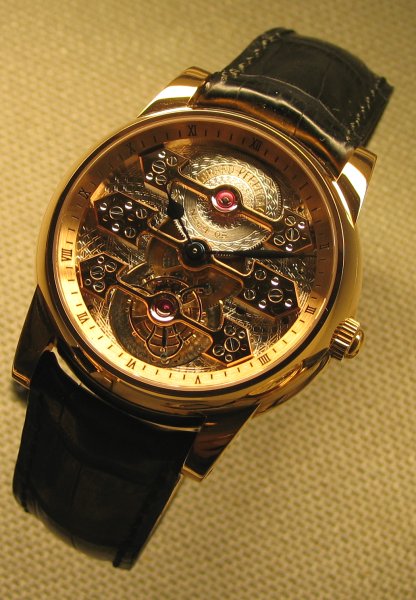
Adaptation of this unique eye-catching design to wristwatches occurred in 1991 and caused quite a stir. However, different from their tourbillon pocketwatches, the design engineers decided to invert the mechanism before installing it in a wristwatch case so that the painstakingly crafted bridges and the tourbillon cage would be visible on the dial side of the watch rather than hidden from view on its underside. As shown below, the movement having finely shaped symmetrical solid gold bridges, solid gold wheel train, and tourbillon is prominently displayed through the dial. The three milled gold bridges are so emphatically present on the dial that they steal the show from all of the other components. Even the dial's legibility is somewhat subsumed by the bridge's beauty.
Since then the concept of the Tourbillon Under 3 Gold Bridges has been applied to movements having variations such as hand-wound, hand wound with chronograph, one with a minute repeater that renders time audible, automatic with micro-rotor, and the ultimate, the Opera One (US $ 375,000) which features a carillon striking work that imitates the bells that chime at Westminister Cathedral in London. An Opera Two adds a perpetual calendar with date, day, month, and leap year to the Opera One. Another application of the tourbillon regulator was the flying tourbillon invented in Saxony, Germany in the 1920s by Alfred Helwig. While tourbillon carriages are normally pivot mounted on one side and bridged on the other, or bridged on both sides, the flying tourbillon's carriage is pivot mounted on one side with no supporting bridge to tie it down. This gives the tourbillon the impression that it is floating in mid-air thus voiding all gravitational pull. The flying type of tourbillon regulator is being produced by manufactures like Blancpain, IWC, and Glashutte Original, and independent watchmakers such as Vincent Calabrese.
The revived brand Blancpain has several flying tourbillon offerings that are included with chronographs, split-second chronographs, perpetual calendars, and rattrapante perpetual calendars. Some of their tourbillon models even have an eight days power reserve. With only the same number of turns of the crown required of a common 2 day movement, an 8 days power reserve can be achieved.
In the 1990s, Blancpain created the ultra-complicated Self-Winding Tourbillon Split-Seconds Flyback Chronograph watch (US $115,000). In 2001, Blancpain unveiled the Quattro platinum watch - an elegant self-wound timepiece housing a tourbillon regulator, perpetual calendar, flyback chronograph, and split-seconds chronograph (US $150,000). To celebrate Blancpain's original founding in 1735, a model aptly named the "1735" puts all that is possible in today's microtechnical industry in a diminitive amount of space. This one single wristwatch comprises an ultra flat movement outfitted with moonphase, tourbillon, perpetual calendar, split-seconds chronograph, minute repeater, and automatic winding (US $684,000).
A reverso watch housing a tourbillon regulator was launched by the prestigious watch manufacture Jaeger-LeCoultre in 1993. The legendary Reverso watch was first presented to the world in 1931 and was an immediate hit - and to this day, the Reverso model family is the most well-known product made by Jaeger-LeCoultre.

The solid gold case swivels to reveal the Jaeger-LeCoultre tourbillon. The tourbillon movement, caliber 828 is a manual winding movement with a 45-hour autonomy. The tiny tourbillon cage alone, weighing a mere 0.25 of a gram, carries seventy parts. As with all Patek Philippe tourbillon watches, on the finished watch, Jaeger-LeCoultre's tourbillon regulator is visible only through the caseback, ... but as it is a reversal, the wearer enjoys the privilege of presenting it in front at their own leisure. (US $65,000 for platinum version).

But Jaeger-LeCoultre's Gyrotourbillon I (US $275,000) that was unveiled in 2005 beats everything that has come out of the company until now: the watch combines a tourbillon with a perpetual calendar, a running equation of time, a double retrograde date display, and an eight-day power reserve. The tourbillon itself is made of two carriages to allow multi-directional rotation more suited to wristwatches than the pocket watches for which the tourbillon was invented. The external carriage, made of aluminum, turns every 60 seconds. The internal carriage, made of aluminum and titanium, turns every 24 seconds.
In 1795, Breguet invents the tourbillon. Then came the flying tourbillon invented in Glash¡§©ötte, Germany - a tourbillon with no bridge. In 1993, Mr. Kiu Tai Yu invents the mystery tourbillon - a tourbillon with no bridge, no carriage.
Born in 1946 in Soochow, China, Kiu Tai Yu, at an early age, discovered a talent for fixing broken watches and clocks. Friends and family would bring him heirlooms of great value to be repaired, and he memorized their mechanical structure and craftsmanship. Entirely self-taught, he built his first watch at the young age of 23. On his 45th birthday in 1991, Kiu Tai Yu astonished the horological world by making the first Asian tourbillon entirely on his own. The last time China made any impact on the horological world was about 10 centuries ago when Su Song, an imperial attendant was commissioned by the dragon throne to construct a time measuring instrument as a standard for the Celestial Kingdom. His ingenious solution was a water clock, the first timepiece ever to have a mechanical escapement, and is thus the direct ancestor of today's Rolex.
Mr. Kiu Tai Yu reduced the elaborate European tourbillon to its barest functional essentials in the Kiu Tai Yu Mystery Tourbillon. The escapement and balance are not housed in a rotating cage and its bridge (as in the traditional tourbillon), and without visible means of support. To create the illusion, Mr. Kiu Tai Yu suspends the balance wheel, with the balance spring underneath, from an invisible bar of crystal. Although Mr. Kiu Tai Yu has attended every Baselworld show since 1992 exhibiting his unique watches, sorry his watches aren't for sale. For Your Eyes Only!
In 1994, in celebration of Omega's 100th anniversary (1894-1994), Omega created the world's first Central Tourbillon wristwatch (US $40,000.00). For the first time, the tourbillon mechanism running at 21,600 vph holds a major place - in the center of the watch. The hour and minute hands are painted on two revolving sapphire discs. The gear mechanism for the sapphire discs is moved to the periphery of the dial, to make room for the escapement and tourbillon cage in the center, which itself carries the seconds hand the OMEGA symbol Ω. Due to the layout of the gear mechanism, the crown is used only for winding up the watch with time setting functions provided from a wheel on the back of the watch.


IWC's Da Vinci Tourbillon (US $59,000) combines a tourbillon, chronograph, perpetual calendar with date, day, month, four digit year display, and moon phase. The calendar will show an absolutely correct date until 2499 thanks to its "century disc."
The IWC 7 days Portuguese Tourbillon Mystere (US $89,000): The flying tourbillon seems to float freely above the black wheel that propels it.
Zenith presented its first tourbillon at Baselworld in 2004. Three years in the making, Zenith's El Primero Grande ChronoMaster XXT (US $104,000) combines a tourbillon with a chronograph and is the world's first and only tourbillon with a balance that beats 36,000 times per hour. The tourbillon is incorporated into an automatic chronograph movement and is encircled by a date ring that moves counter-clockwise.
The name "Frank Muller" is no stranger to watch enthusiasts. The meteoric rise that has characterized the Frank Muller brand in only one decade is without equal in recent watch history. Launched in 1992, Frank Muller's line of mechanical timepieces, marvelous both inside and outside, feature complex pieces as minute repeaters, perpetual calendars, and of course tourbillons. Among his more celebrated watches is the Tourbillon Revolution, introduced in 2002 to celebrate the tenth anniversary of the company. Protected by several patents, what makes this tourbillon watch so different and exciting is that with the simple push of a button on the case, the hour and minute hands sweep to the 12:00 position and like magic, the tourbillon cage rises from the movement level to literally hover over the dial for better viewing. The axial displacement forces the tourbillon cage to the surface - the hands taken out of the way - remain at 12 o'clock for as long as the tourbillon lift button remains pressed. An extremely complex mechanism, this timepiece also offers power reserve of approximately 70 hours. Among the other watch brands, Frank Muller's Tourbillon Revolution series are perhaps the only tourbillon watches to have such a unique feature, a timepiece paying homage as no other to the playful instincts of man.
A year later, he outdid himself once again by presenting to the world his Double Axis Tourbillon, aptly called the Revolution 2. Attached by suspension and sitting in a spherical cage like a ballerina, the double axis tourbillon revolves along two axes, rotates as if on tippy toes, while simultaneously performing a series of somersaults. On either side of the dial opening are two retrograde indicators - one going from 0 to 60, to show the revolving time the tourbillon cage makes along its more traditional axis while also functioning as the seconds hand, and the other indicator graduated from 0 to 8 minutes to show the time the tourbillon cage takes to revolve along its new double "revolutionary" axis. Costs of ownership for one will set you back about US $635,000.00, give or take a few dollars.
After Tourbillon Revolution 2, it was almost an obligation for the company to present Tourbillon Revolution 3. And present it, they did - the new three axis tourbillon rotates on three axes, the cages revolve at varying speeds: the inner cage every 60 seconds, the second cage every 8 minutes, and the large, outer cage once an hour. The complete movement comprises 289 finely crafted components worked individually by hand.
Since the tourbillon's 200th anniversary in 2001, the number of brands incorporating the tourbillon into their own wristwatches has increased exponentially. While in 2001, there may have been fewer than fourteen companies to feature such a highlight in their collections, at last count in 2005 there were more than fifty doing so. Nearly all major brands as of this writing has a tourbillon timepiece in their collection.
Several Reasons Why Tourbillon Watches Are Held High Admiration
Why all the tourbillon admiration? There are several reasons why tourbillon watches are held in such high admiration and esteem today.
First of all, the veneration given the tourbillon is due to the unquestioned and deserved prestige of its inventor Abraham Louis Breguet, rightly called the "watchmaker of kings and the king of watchmakers." In his quest for greater precision, Breguet came up with the idea of a mechanism that would compensate for the deviation in running accuracy that he observed when pocket watches were tested in vertical positions. His concept was a rotating cage that would bear all of the parts of the escapement; in its center, the tourbillon cage would carry the regulating organ (the balance); and the escape-pinion would revolve around the second wheel. See structure of the tourbillon. This rotary movement compensates for the running deviations observed in the vertical positions. This is a decisive advantage for a watch, especially for a pocketwatch worn close to the body that spends most of its working life in a vertical position.
A further reason for the tourbillon admiration is our romance associated with mechanical wristwatches. With the rebirth in popularity of the mechanical watch back in the mid- to late-1980s, the tourbillon watch represented to many, the epitome of that renaissance. Some authorities have even credited Audemars Piguet's Tourbillon 1, an ultrathin bumper automatic lever tourbillon wristwatch developed in 1986 for starting the craze of the mechanical revival. With more than a century having passed since Breguet invented the tourbillon for packet watches, Audemars Piguet was the first company to develop a tourbillon for wristwatches. In fact, from 1860 until 1980 only 650 tourbillons (all of course for pocket watches) were produced worldwide for all brands combined! Since the debut of Audemars Piguet's Tourbillon 1 in 1986, there has been an amazing explosion of tourbillon wristwatches, testament to the romance of the tourbillon regulator.
Another reason for the tourbillon admiration is the technical difficulty involved in their manufacture. Even in its most basic design, it is extremely hard to manufacture and can be carried out only by particularly skilled watchmakers. In watchmaking circles, creating a tourbillon is regarded as the consummation of a craftman's skills. The complexity of its manufacture alone guarantees that only a few watchmakers are capable of this masterful achievement, so it comes as no surprise that, over the past few years, several brands have relied on offering this complication as proof of their technical prowess.
Over the generations of watchmakers since Breguet, there were probably fewer than 250 able to execute such a masterpiece. The tourbillon cage is made under extremely precise mechanical tolerances and it cannot have much weight or friction. At a time when computers did not exist and all tools were still somewhat primitive, the production of a tourbillon watch was a certificate of competence far more appreciated than the diplomas awarded by the best watchmaking schools. International Watch Company's (IWC) "Il Destriero Scafusia" tourbillon model demonstrates the complexity of the mechanism. It is manufactured of approximately 100 parts, and weighs only 0.296 grams.


The tourbillon in the "Destriero" consists of 100 individual parts and weights just 0.296 grams:
1. Upper part of cage in titanium
2. Balance
3. Escapement bridge in titanium
4. Middle section of cage in titanium
5. Pallets
6. Escape wheel
7. Shock resistant supports
8. Lower part of cage in titanium with pinion
9. Fixed fourth wheel
Yet another explanation for the tourbillon admiration is that most tourbillon pocket watches presented in observatories for timing in the 19th century, were manufactured by renowned watchmakers or companies.
First of all, the veneration given the tourbillon is due to the unquestioned and deserved prestige of its inventor Abraham Louis Breguet, rightly called the "watchmaker of kings and the king of watchmakers." In his quest for greater precision, Breguet came up with the idea of a mechanism that would compensate for the deviation in running accuracy that he observed when pocket watches were tested in vertical positions. His concept was a rotating cage that would bear all of the parts of the escapement; in its center, the tourbillon cage would carry the regulating organ (the balance); and the escape-pinion would revolve around the second wheel. See structure of the tourbillon. This rotary movement compensates for the running deviations observed in the vertical positions. This is a decisive advantage for a watch, especially for a pocketwatch worn close to the body that spends most of its working life in a vertical position.
A further reason for the tourbillon admiration is our romance associated with mechanical wristwatches. With the rebirth in popularity of the mechanical watch back in the mid- to late-1980s, the tourbillon watch represented to many, the epitome of that renaissance. Some authorities have even credited Audemars Piguet's Tourbillon 1, an ultrathin bumper automatic lever tourbillon wristwatch developed in 1986 for starting the craze of the mechanical revival. With more than a century having passed since Breguet invented the tourbillon for packet watches, Audemars Piguet was the first company to develop a tourbillon for wristwatches. In fact, from 1860 until 1980 only 650 tourbillons (all of course for pocket watches) were produced worldwide for all brands combined! Since the debut of Audemars Piguet's Tourbillon 1 in 1986, there has been an amazing explosion of tourbillon wristwatches, testament to the romance of the tourbillon regulator.
Another reason for the tourbillon admiration is the technical difficulty involved in their manufacture. Even in its most basic design, it is extremely hard to manufacture and can be carried out only by particularly skilled watchmakers. In watchmaking circles, creating a tourbillon is regarded as the consummation of a craftman's skills. The complexity of its manufacture alone guarantees that only a few watchmakers are capable of this masterful achievement, so it comes as no surprise that, over the past few years, several brands have relied on offering this complication as proof of their technical prowess.
Over the generations of watchmakers since Breguet, there were probably fewer than 250 able to execute such a masterpiece. The tourbillon cage is made under extremely precise mechanical tolerances and it cannot have much weight or friction. At a time when computers did not exist and all tools were still somewhat primitive, the production of a tourbillon watch was a certificate of competence far more appreciated than the diplomas awarded by the best watchmaking schools. International Watch Company's (IWC) "Il Destriero Scafusia" tourbillon model demonstrates the complexity of the mechanism. It is manufactured of approximately 100 parts, and weighs only 0.296 grams.


The tourbillon in the "Destriero" consists of 100 individual parts and weights just 0.296 grams:
1. Upper part of cage in titanium
2. Balance
3. Escapement bridge in titanium
4. Middle section of cage in titanium
5. Pallets
6. Escape wheel
7. Shock resistant supports
8. Lower part of cage in titanium with pinion
9. Fixed fourth wheel
Yet another explanation for the tourbillon admiration is that most tourbillon pocket watches presented in observatories for timing in the 19th century, were manufactured by renowned watchmakers or companies.
Friday, May 28, 2010
Structure of The Tourbillon

Here is a graphical illustration of the tourbillon parts. The tourbillon device has the escape wheel, lever, and balance wheel all mounted in a carriage made of a lightweight material (usually titanium). The carriage turns 360 degrees at regular intervals (usually once per minute). The fourth wheel (not shown) is fixed and is concentric with the carriage pinion and arbor. The escape wheel pinion meshes with the fourth wheel and rotates around the fourth wheel in the fashion of a satellite. The escape wheel and lever are mounted on the carriage, and the third wheel (not shown) drives the carriage pinion, turning the carriage once every minute. This rotation of the escapement helps reduce the positional errors of a watch.
Subscribe to:
Posts (Atom)